Saturday, April 23, 2022

In-Person Presentation and Walk- Edible Wild Plants and Fungi of Summer, June 25, 10:00am


Staghorn sumac


You must register directly with Flanders Nature Center, clicking "going" on this posting is not registering! There is a fee for this program. Contact Flanders Nature Center at 203-263-3711 


The program takes place at the Sugar House, down Church Hill Rd.
 
The summer months are a bounty of ripe berries, nectar-laden edible flowers, amazing edible plants along the seashore, and edible mushrooms that can carpet the forest floor after warm, rainy days. Learn how to identify, sustainably harvest, and prepare the wild foods of summer, from beach plums to invasive wineberries, including some of the choice summer fungi like chanterelles and the myriad of pored Boletes. Join The 3 Foragers as they teach the edible plants and fungi of summer with their original photos and recipe ideas featured in an educational slideshow and a walk through the grounds.

Golden chanterelles


Online Zoom Program, Edible Wild Plants and Fungi of Summer, June 8, 6:30 pm


Wineberries


You must register ahead of time directly with the Bloomfield Public Library.


The summer months are a bounty of ripe berries, nectar-laden edible flowers, amazing edible plants along the seashore, and edible mushrooms that can carpet the forest floor after warm, rainy days. Learn how to identify, sustainably harvest, and prepare the wild foods of summer, from beach plums to invasive wineberries, including some of the choice summer fungi like chanterelles and the myriad of pored Boletes. Join The 3 Foragers as they teach the edible plants and fungi of summer with their original photos and recipe ideas featured in an educational slideshow. 
 
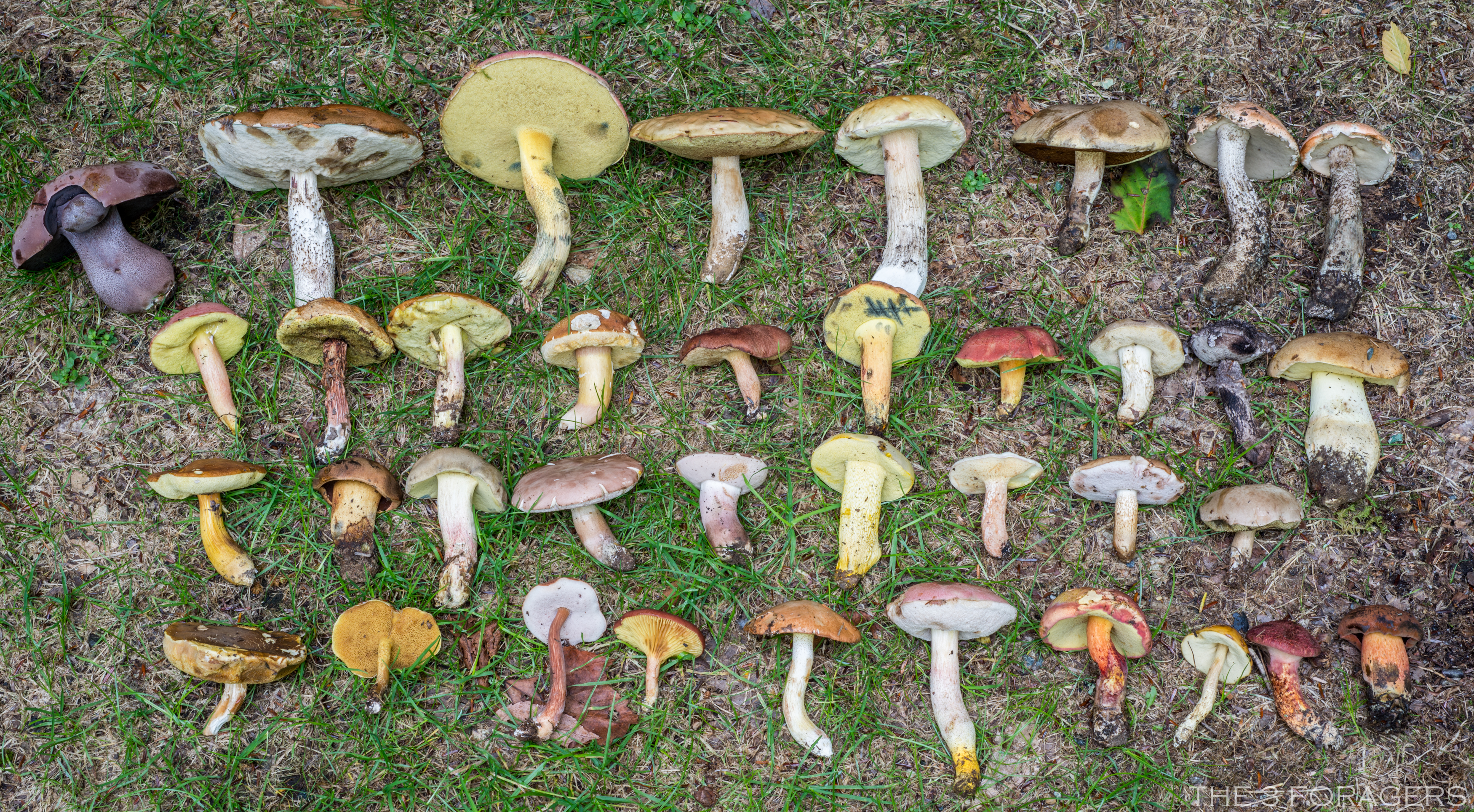
Assorted Summer Boletes


Wednesday, April 20, 2022

Foraging Walk, May 7 10:00am, Central Connecticut


Daylily

As the warmer temperatures and longer days of spring unfold, many tender, young edible shoots, plants, flowers, and even a few fungi awaken a forager’s senses and delight. Learn how to identify, sustainably harvest, and prepare the wild foods of spring, from invasive bamboo shoots to the lemony tang of fresh wood sorrel, including some of the early edible fungi of the season. In this 2+hour ramble we will explore the verges, forests, and fields to find edibles. Educational handouts provided. This site is mainly for teaching, not actual harvesting in large quantities, so we suggest bringing a notebook and pen for taking notes, camera for taking photos, and your curiosity! 


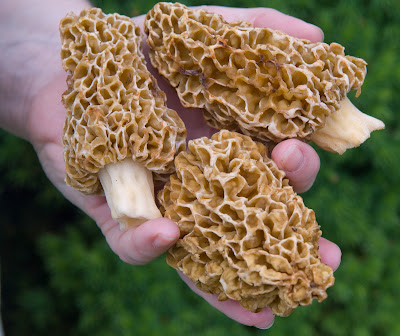
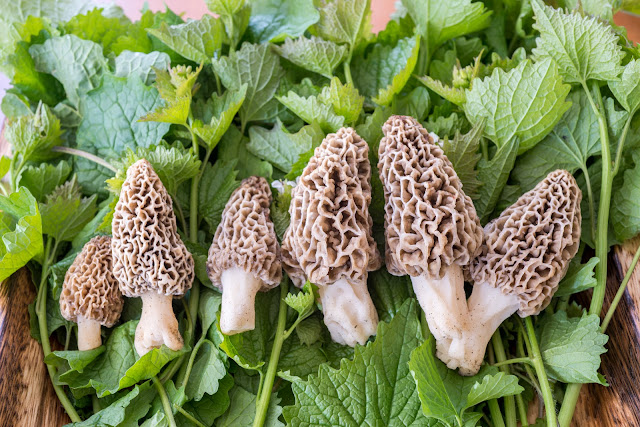
Yellow morels

The 3 Foragers have been studying, photographing, and eating wild foods since 2005, and have given over 150 educational walks, lectures, and private classes for libraries, land trusts, nature centers, summer camps, and garden clubs since 2016. 

Walk will take place May 7 at 10:00am in Simsbury, CT.

Contact The 3 Foragers directly at kraczewski@comcast.net for exact location and payment information, reservation required. Class is $20 per person 16 and older, free for younger children. Minimum of 15 people needed for the class to happen, maximum of 30 people.


Japanese knotweed


Saturday, April 16, 2022

Foraging Walk- April 30- Western Connecticut


Japanese knotweed shoots

As the warmer temperatures and longer days of spring unfold, many tender, young edible shoots, plants, flowers, and even a few fungi awaken a forager’s senses and delight. Learn how to identify, sustainably harvest, and prepare the wild foods of spring, from invasive bamboo shoots to the lemony tang of fresh wood sorrel, including some of the early edible fungi of the season. In this 2+hour ramble we will explore the verges, forests, and fields to find edibles. Educational handouts provided. This site is mainly for teaching, not actual harvesting in large quantities, so we suggest bringing a notebook and pen for taking notes, camera for taking photos, and your curiosity!
 
Yellow rocket
 
 
The 3 Foragers have been studying, photographing, and eating wild foods since 2005, and have given over 150 educational walks, lectures, and private classes for libraries, land trusts, nature centers, summer camps, and garden clubs since 2016.
 
Yellow morels and asparagus


The 2:00pm walk will take place in Southbury, CT.
 
Contact The 3 Foragers directly at kraczewski@comcast.net or 860-639-9385 for exact location and payment information, reservation required. Class is $20 per person 16 and older, free for younger children. Minimum of 15 people needed for the class to happen, maximum of 30 people.


Friday, April 15, 2022

Edible Mushrooms of Spring, southern New England


Morels and garlic mustard

Spring mushrooming in Connecticut and southern New England in general can be a little slow. Soil and air temperatures fluctuate seasonally, and rain can be sporadic. The "season" can begin as early as April, and generally runs through mid-June. While there are many small bumps on logs and dried polypores to examine, there are relatively few species of edibles (at least compared to the species in summer and autumn) to be found in the spring. It should also be noted that there is a scale of edibility to recognize: choice or great edibles, edible (I prefer to think of them as simply non-toxic at this level; cook them up with butter and salt, and all you will taste will be butter and salt. An "edible" designated mushroom has no real interesting flavor or texture that sets it apart from a basic white button grocery store mushroom), and non edible (whether due to toxins or texture).
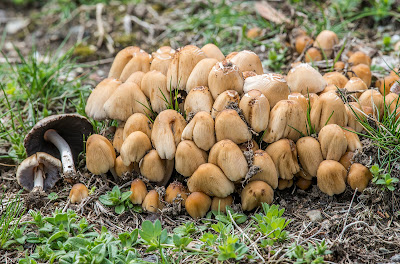
Mica caps

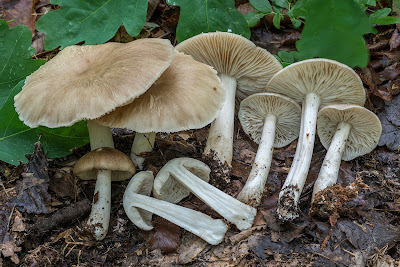
Deer mushroom

Platterfull mushroom


Three spring mushrooms I consider "edible" but won't bother collecting due to lack of flavor and poor texture are mica caps (Coprinellus micaceus), deer mushroom (Pleutues cervinus), and the platter-full mushroom (Megacollybia rodmani). Mica caps can be plentiful, but often full of dirt, and as one of the inky mushrooms, will deliquesce if not cooked quickly. Deer mushrooms are quite flavorless and cook up rather floppy, and platterfull mushrooms are nearly all gills. Without extensive and involved prep using skills and techniques that the average home cook does not posses, these three mushrooms *in my opinion* are not good edibles in spring.

And why bother with less-than-desirable mushrooms when there are a number of very good to choice mushrooms to be found?

Morels (Morchella sp.) are the spring edible that many seek, but is not nearly as plentiful here as it is in the mid-west, Appalachian region, and on the west coast after burns. They have a pitted cap, a lighter colored stem, and are hollow. Depending on species, the cap can be attached or attached at the mid-pint, or attached at the top of the inside of the cap. Depending on species, they can be delicate and small 1-2" or chunkier and taller at 3"-5". There is still ongoing DNA studies being done on identifying morels, so their binomials are changing.
Morchella dimunutiva


Morchella americana

Morchella punctipes


Oyster mushrooms (Pleurotus ostreatus) can be found in spring; indeed all winter if it has been mild enough. The spring oysters tend to have light brown caps, and the yellow oysters (Pleurotus citrinopileatus) will soon be invading our geographic area after spreading throughout the mid-west. Oysters are gilled and grow from dead or nearly-dead hardwood, and can be cultivated at home. They offer very good flavor and texture when sauteed, grilled, or roasted. Wine caps (Stropharia rugosoannulata) are another gilled, saprobic mushroom, but are found growing in wood chips of the cooler spring and autumn months, and can also be cultivated at home. The caps can be burgundy but that color can fade; there is also a lighter variety that has a yellowish cap to begin with. There is often a large cog-wheel like ring on the stem, and the gills start off pale grey maturing to dark purplish grey. Wine caps are meaty mushrooms and have a stronger flavor that works well stuffed and baked, grilled, or cooked into risotto.
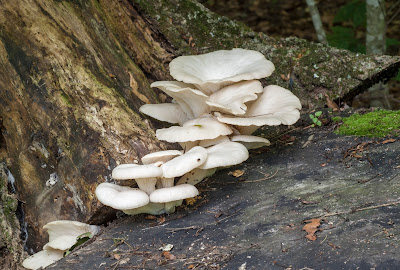
Oyster mushroom

Wine caps

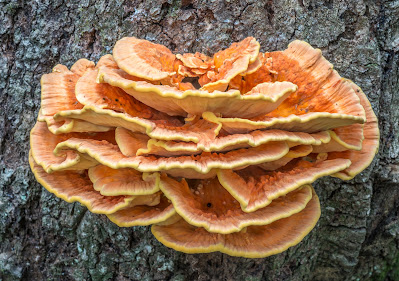
Two polypores that can be collected while still young and tender are the dryad's saddle (Cerioporus squamosus) and the chicken (Laetiporus sulphureus). Both are saprobic, growing from wood, and will become tough and inedible with age. Dryad's saddle has an excellent crisp texture and a stronger flavor than most mushrooms; making it ideal for pickling or using in strongly flavored dishes. There are fine tufts of hairs on the caps and the pore surface smells like watermelon rind or cucumber. Chicken mushrooms don't taste exactly like chicken; it is more the texture of a prime specimen will strongly mimic the texture of chicken when cooked well. They can take on any cooking method and any flavors--poaching, frying, sauteing, baking, mincing or grinding, simple bread crumb coating, BBQ spices and sauce, poultry seasoning, ginger and garlic aromatics, and any marinade. Chicken mushroom is a wonderful meat substitute for a vegetarian meal.
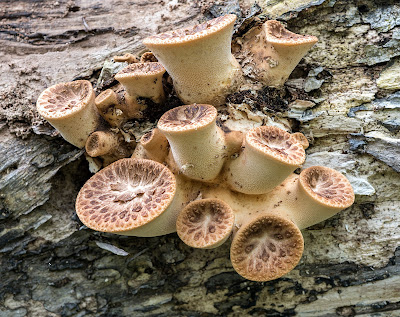
Dryad's saddle

Chicken mushroom

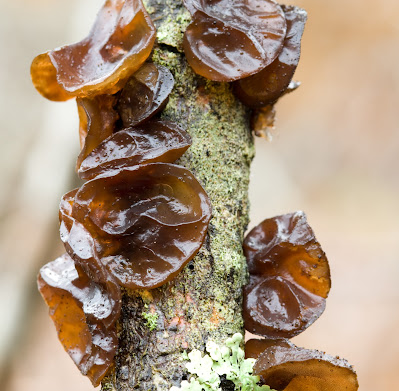
 Finally, another spring mushroom worth hunting is the wood ear mushroom (Auricularia "americana" group). True wood ears are in binomial flux, and the name will change. Wood ears grow on wood, are gelatinous in texture, and have a fine coating of fuzzy hairs on one side. Not all brown jellies are "wood ears," many are from the genus Exidia but are still equally edible. Wood ears themselves don't have a lot of flavor, but provide an interesting textural contrast when added to soups and stir fries. They dehydrate and reconstitute well in water.
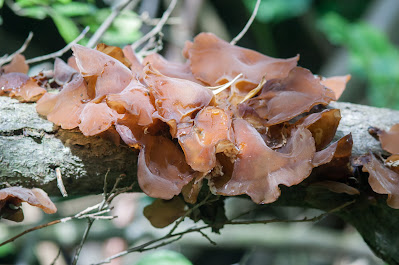
Wood ears

NOT woods ears, but Exidia crenulata brown jelly


Monday, April 27, 2020

Spring Shoots, Mushrooms, and Greens-Dinnertime!


Spring is coming along slowly this year, it has been chilly and damp, plenty of April Showers. A few treks into our local woods yielded some early edibles: nettle shoots, ramps greens, garlic mustard, and morels. Dinners have been wild this week!


Stinging nettles (Urtica dioica)are out in open fields and along the edges of the woods, They are covered in small, stinging hairs that inject you with a mix of histamines and acids, producing the "sting". Nettles are high in soluble iron and proteins, a super green vegetable to use as a spring tonic.

Soup made with nettle greens, spinach, and ramps greens, with topu croutons


We do have a very local spot where we often find a handful of morels each year. This year the yellow morels (Morchella americana) have popped early in this one spot, it is a really exposed area that gets plenty of direct sunlight. We headed back twice, finding more than two dozen good-sized mushrooms. Morels are a highly sought after mushroom with a very earthy flavor, and they can be preserved by drying. It is very important to slice your morels in half to make sure they are completely hollow (and to make sure there are no slugs hiding!)


Garlic mustard (Alliaria petiolata) is a very abundant and invasive weed that most people want to eradicate from their property. It is biennial, and the second year's growth has already shot up with the flower cluster at the top. Garlic mustard is in the mustard family and can be a bit bitter for beginners, but we eat so much that we are used to the pungency and can eat it as a side of sauteed greens.

Potato and morel hash with a side of sauteed garlic mustard greens
Irish boxty made with morels and ramps greens

Ramps (Allium tricoccum) have sprouted in southern New England, and we have collected a few from several different patches that we visit. Ramps are a wild leek with a fantastic funky-garlic flavor. We only collect one leaf from each plant, allowing the bulb to stay and reproduce for future years; besides all of the flavor we want is found in the leaves, along with the goodness of a green vegetable.

Flaxseed braided breads stuffed with potatoes and ramps greens

Chinese flower steamed buns with chopped ramps greens

Sunday, February 2, 2020

Dandelion Root Pudding Recipe


Wintertime is a good time for us to go over our stores of wild food from the previous seasons and use them in some dishes and recipes. Here we used dandelion root powder to make a smooth, creamy, and deeply flavored pudding for dessert. We make the powder by digging up the long, tough taproot of dandelions in the spring or autumn, then scrubbing them well until they are free from dirt. Then they get roasted in a low temperature oven until they are dry, you will start to smell the wonderful coffee-chocolate-like aroma after about 30 minutes. Once the roots are totally dried and brittle, they get ground into powder using either the blender of a coffee grinder. The powder is then kept in a airtight jar until we want to use it to make a coffee-like hot drink or use the powder as a flavoring in other recipes.

For this pudding, we made a vegan pudding with a blend of almondmilk and coconut milk from the can, but you could use dairy milk as well. We also used weight measurements since they are far more accurate than volumetric measurements in many cases.

Dandelion Root Pudding-makes about 8 servings

200 g almondmilk
15 g dandelion root powder
200 g coconut milk (from a can)
70 g sugar
30 g coconut oil
25 g tapioca starch
1/2 tsp agar agar powder
1/2 tsp vanilla extract

1. In a medium saucepan, add the almondmilk and dandelion root powder and simmer for 3 minutes. Remove from the heat and let it steep for 10 minutes. Filter the mixture through a coffee filter to remove the solids.
2. Add the almondmilk back to the saucepan and add the remaining ingredients. Bring the mixture up to a boil and cook for 3 minutes, stirring constantly.
3. Remove the pudding mixture from the heat and allow to cool to room temperature. It will thicken slightly and be a bit gooey.
4. Place the mixture in the blender and whir it for 30 seconds, until smooth. Pour the pudding into serving cups and chill in the refrigerator.