Showing posts sorted by relevance for query black trumpet. Sort by date Show all posts

Friday, April 29, 2016

Black Trumpet Recipe - Black Trumpet Pasta


For me, the most fragrant and distinct tasting wild mushroom is the black trumpet, with its earthy, iron-y, and rich flavors. Based on newest DNA studies, it appears the black trumpets of eastern North America are a separate genus from those in Europe and the West Coast, ours being Craterellus fallax, displaying a peachy-salmon spore print. Classify it any way you like, but let me eat my black trumpets!


We hunt black trumpets in the hot summer months, after the rains have made the forests damp and humid, and the mosquitoes swarm your ears with their whine. In this area of New England, we find black trumpets in mixed forests, associated with smooth-barked beech trees. The trumpets are almost impossible to detect among the leaf litter on the forest floor, appearing more as an absence of color when you look into their black funnel. Finding them along gentle slopes, nestled in soft, green club moss is easier on the eyes, if harder on the knees to pick while standing at an angle. Black trumpets grow in groups, sometimes great, expansive groups; you can fill several paper sacks within a half hour before making a trip back to the car for more paper sacks. 


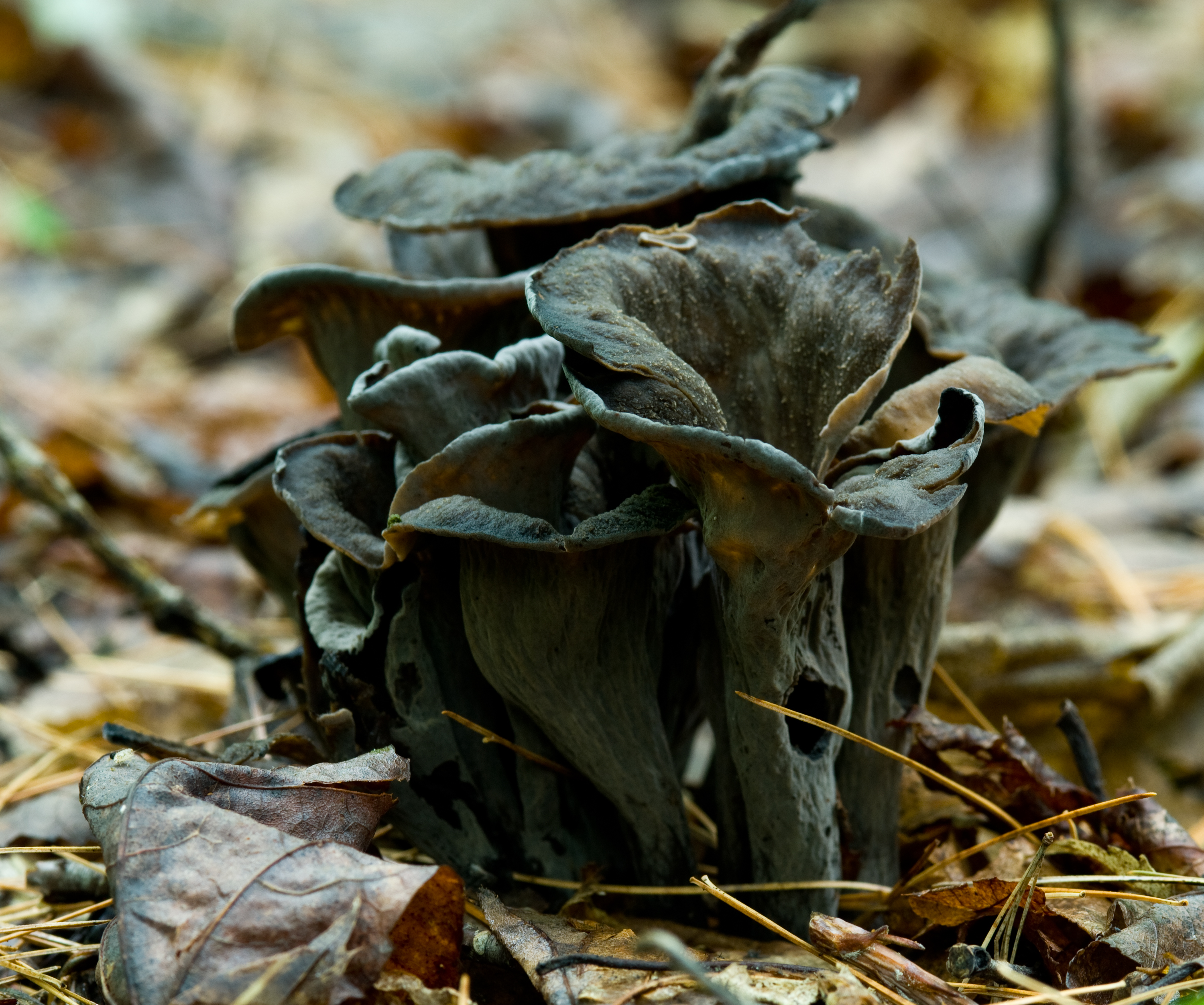
Black trumpets are vase-shaped, or like the throat and bell of a trumpet. The stem is hollow, tapering down to the base, and can catch debris, sometimes bugs, and even small frogs. We pinch off the trumpets at the lowest point of the base and give them a quick inspection and shake to dislodge anything "extra". The top edge is often curled outward, and the inside is dark grey or brownish-black, sometimes minutely scaly. The outside has neither gills nor pores, but can have some ridges or be completely smooth, and is often a lighter grey.


Black trumpets dehydrate incredibly well; our many, full gallon jars on the shelves testify to that fact. They reconstitute easily with boiling water or heavy cream since they are so thin. We also sauté them lightly to reduce their volume before vacuum packing them for the freezer. Once dried, they can be made into an intense flavoring powder, which can be added to dough, sauces, or any other recipe that would benefit from the flavor of black trumpets. 


For this pasta, use the dried, powdered black trumpets. The color of the pasta will lighten considerably when dried, but will regain the darkness once cooked. It pairs nicely with a creamy sauce, we eat it with a stinging nettle béchamel.


Black Trumpet Pasta                makes about 4 servings, one pound

US measurements:
10.6 oz semolina flour
1.2 oz dried, finely ground black trumpets 
1/2 tsp salt
2/3 c. water
2 Tbsp oil

International measurements:
300 g semolina flour
30 g dried, finely ground black trumpets
3 g salt
150 g water
20 g oil

1. In a bowl, combine the semolina flour with the salt.
2. Combine the dried, powdered black trumpets, oil, and water in a high speed blender, blend 1 minute. Pour into the semolina flour, and mix until a dough forms.
3. Knead the dough for 5 minutes, allow it to rest for 5 minutes, then knead it further for 5 minutes.
4. Wrap the dough in plastic or cover with a damp towel, and allow it to rest at least 30 minutes. It can be refrigerated for a day or so if tightly wrapped.
5. Cut the dough ball into quarters, and use a pasta roller to roll it out into flat sheets, starting at level 1 and rolling it down to level 5 thickness, re-folding and rolling it again if it is falling apart. The more you work it, the smoother it becomes. We like the fettuccine size cut for this firm dough.
6. Dry the pasta and store, or cook fresh in plenty of salted, boiling water, about 2-3 minutes, until al dente. Toss with butter or a sauce, and serve.


Friday, September 20, 2013

Black Trumpet Recipe - Black Trumpet Choux Bombs


We attend several mycophagy potlucks in a year and often bring a dish that is made with foraged foods, since our mushroom education is still developing and I never felt confident enough to identify and cook mushrooms for people other than ourselves. After three years of study, identification and experimenting, we finally cooked with wild mushrooms for a group, starting with a crowd-pleaser, the black trumpet.


We had about two gallons of dried black trumpets (Craterellus fallax) left over from last season that I decided to try to work with for an upcoming potluck, and had just found a few handfuls of fresh black trumpets to use as well. I thought I might make some savory pâte à choux puffs flavored with dried trumpets, and fill them with a rich black trumpet cream cheese as an appetizer.  I powdered the dried trumpets in a small coffee grinder, grinding some to a coarser grind, like cracked black pepper and some to a fine powder. I used the fresh, lightly sauteed trumpets in the cream cheese filling. I filled the puffs right before service so they wouldn't get too soft. This recipe makes about 36-48 puffs, depending on the size of the scoop, I used a 1 tsp. scoop, or you could use a piping bag to shape the puffs before baking. Making the choux puffs might sound wordy and complicated, but it is not too hard.


Black Trumpet Choux Bombs                      Makes about 36-48

1 c. flour
1 c. water
3/4 tsp salt
4 Tbsp butter
4 large eggs
1 Tbsp powdered black trumpets
2 Tbsp coarsely chopped dried black trumpets

1. Heat the oven to 425º F. Prepare a sheet pan with parchment paper.
2. In a large sautee pan, bring the water, salt and butter to a boil. Quickly stir in all the flour at once to make a paste, and cook until the mixture over medium heat until it pulls away from the sides of the pan and is dry. Transfer to the bowl of a stand mixer fitted with a paddle.
3. With the mixer running on low, add the powdered and coarsely powdered trumpets. Continue to mix for a few minutes to cool the mix.
4. Start adding the eggs, one at a time, mixing until incorporated before adding the next egg. Scrape the sides of the bowl often. You'll end up with a thick paste that can be scooped or piped with a pastry bag into small balls on the sheet pan. They will puff up a bit, so leave about 1" between each puff.
5. Bake at 425º F for 15 minutes, then reduce the heat to 350º F and bake an additional 20-25 minutes until the puffs are dry on the inside. After they are removed from the oven, poke a small hole in each to allow the steam to escape. Each puff should bake up mostly hollow, a perfect place to add a filling.

Black Trumpet Cream Cheese

8 oz. block cream cheese, softened
2 c. fresh black trumpets, chopped
1 Tbsp chopped scallions or chives
1/2 tsp salt
black pepper
1/2 tsp lemon juice

1. Quickly sautee the chopped fresh black trumpets in a little bit of olive oil, just until they are soft.
2. Mix the cooled cooked trumpets into the cream cheese along with the scallions, salt, pepper, and lemon juice. Adjust the seasonings.
3. Using a piping bag, pipe the soft cream cheese filling into the cooled puffs. You could also cut the puffs open and spoon in the filling. Serve soon after filling.


Sunday, August 9, 2015

Mycophagy at NEMF 2015


 Last weekend our mushroom club, Connecticut Valley Mycological Society, was honored to host the 39th Annual Sam Ristich Foray, held by the member mushroom clubs of the Northeast Mycological Federation. Our location was Connecticut College, in New London, Connecticut, allowing us to share the forests and parks of southeastern Connecticut that we are very familiar with. The four-day conference featured organized forays, classes on mushroom dying, medicinal mushrooms, microscopy, taxonomic name changes, and toxic mushrooms. We were honored to have as a instructors and identifying mycologists Alan and Arleen Besette, Gary Lincoff, Rick Van de Poll, Dorothy Smullen, Walt Sturgeon, Renee LeBeuf, Roz Lowen, Jason Karakehian, Jon Plischke, Sue Hopkins, Dianna Smith, Rod Tulloss, Alison Birks, Ed Mena, and Bill Yule.

Mycophagy is the cooking and eating of mushrooms for pleasure, and in our case along with a large amount of mushroom hunters, we cook wild mushrooms. Robert and I, along with a few very dedicated and skilled volunteers, cooked up the mycophagy for 190 people on Friday night. Most of the recipes we used are our own, original recipes, while others like the Black Trumpet Soup Shooters were made as we went along, starting from a general idea of what we wanted and tasting as we went along.


Maitake Jerky, made with donated hens (Grifola frondosa) from several CVMS members last fall, as we were not able to find very many ourselves. After the jerky was made last fall, we vacuum packed it to last over the winter, and then portioned it out into small, waxed bags to enjoy as a snack.


Black Trumpet Soup Shooters were served warm in paper espresso cups. It was a lovely, smooth soup made with fresh black trumpets (Craterellus fallax), celery, onions, potatoes, and thyme, with just a touch of cream and a parsley/scallion garnish.


Black Trumpet Choux filled with Black Trumpet Cream Cheese is one of my favorites. The choux pastries were made with dehydrated black trumpets (Craterellus fallax) collected last year while attending the NEMF foray in Maine.We collected many pounds of trumpets; luckily we traveled to the foray with dehydrators and brought home several gallons of dried mushrooms which are powdered for this recipe. The cream cheese filling is made with fresh, sauteed black trumpets and chopped scallions.


Our bolete season is very unpredictable, so bought some West Coast boletes (Boletus regius) from a forager in Oregon to make into these Porcini Polenta Cubes. I rehydrated the dried porcini in vegetable broth before sauteing them butter, then added it all back into the cooked polenta along with Parmesan cheese and fresh parsley.


These are Hen Duchesse Potatoes, a fun appetizer I make often to use up all the little bits and pieces left over when cleaning hens (Grifola frondosa) to make jerky. The hen bits are finely chopped in the food processor with some onion before being browned and oven roasted, then added to mashed potatoes with a bit of egg and seasoning. I pipe them into small cupcake papers and cook them until nicely browned.


Morel and Ramps Greens Biscuits were made from morels (Morchella americana) we collected last spring and ramps greens that we collected and froze from this spring. I had extra rehydrated and sauteed morels, so I blended them into butter to spread onto the biscuits.


Thai King Oyster Skewers are made from a full, 11 pound case of king oysters (Pleurotus eryngii) from the local Asian market. The stems are sliced into discs about 1/4" thick, then sauteed until browned before being poached in a tom-ka broth until the broth reduces. Prepared this way, the mushrooms take on a similar texture as scallops with a Thai-flavored coating of tom-ka.


"Chicken" Sausage Toasts with Garlic Mustard-Mustard and Pickled Ramps uses 3 of our recipes. We stacked the crisped chicken (Laetiporus sulphureus) sausage slices on toasted baguettes with a smear of the spicy mustard (Alliaria petiolata) and a sweet/sour garnish of ramps (Allium tricoccum) pickle.


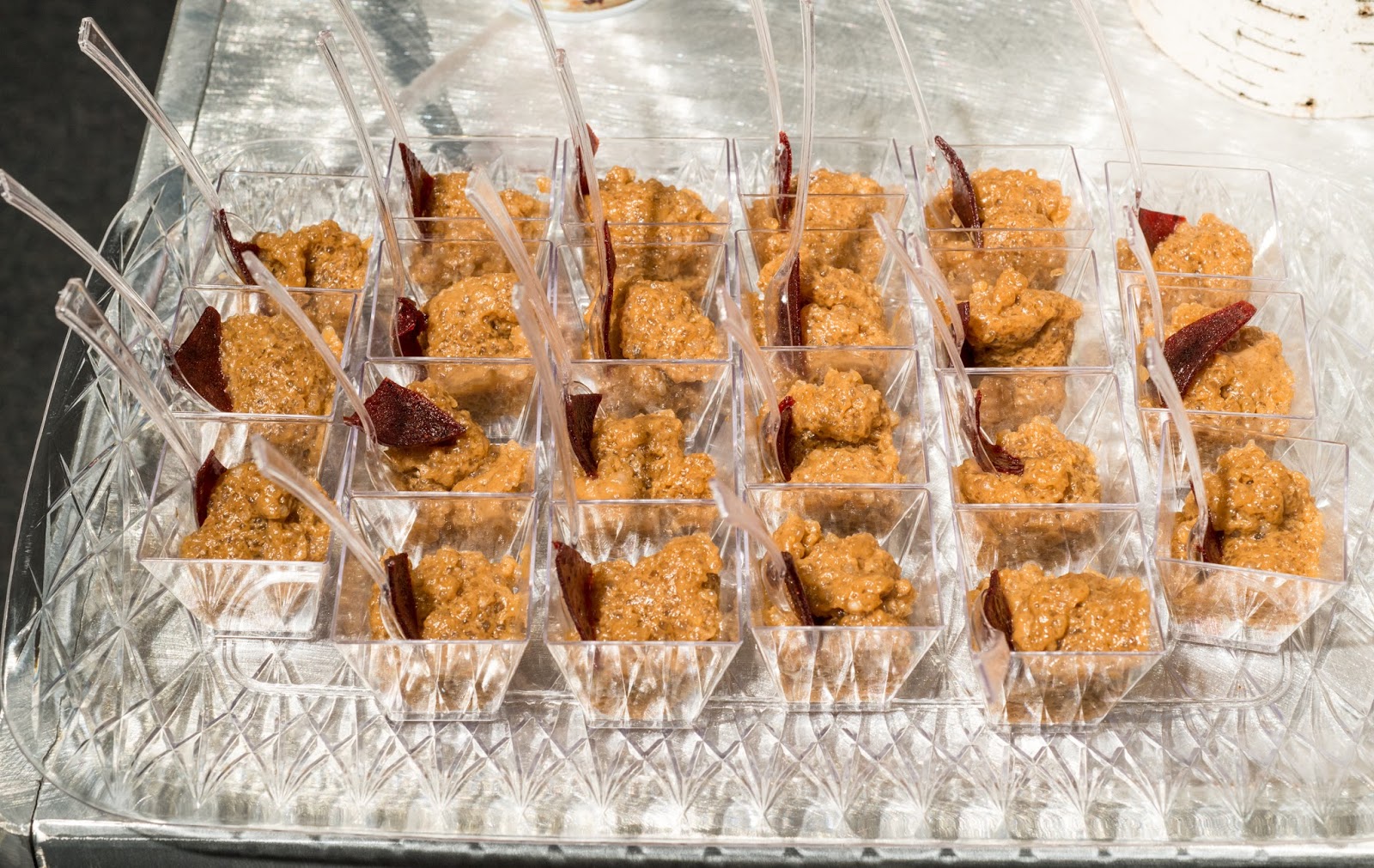
And for our mushroom dessert, we served Chaga Tapioca Pudding garnished with some beach plum fruit leather wedges. First we make Chaga Frappe (Inonotus obliquus) with some coconut milk and maple syrup, then we cook the frappe into a tapioca pudding. Guests were able to add a bit of whipped cream if desired.


The full, double sided table of mushroom goodies

Tuesday, October 4, 2011

Mushrooms Identified - Black Trumpets


Black Trumpet Dauphinoise
Mycology discussion groups in the Northeastern US were buzzing with talk of a monumental year for black trumpet mushrooms (Craterellus fallax), and we saw several specimens at the CVMS forays brought in by other people. Robert and I were very excited to come across some while hiking, he took many pictures and we wondered what we should do with our finds. Then, we were out looking for hen-of-the-woods in a new location when we came across more than 6 pounds of this wonderful fungus. Recipe searches and cooking commenced, and we dried enough to fill 2 gallon jars. The simplest way to eat them was on a pizza with goat cheese and some caramelized onions, and we made a Dauphinoise, soups, and are thinking of making a fondue with brie and black trumpets.

Can you see the trumpets?
Searching for black trumpets takes a slow and patient style, unless you know of some places that they appeared in previous years. They grow in mixed deciduous forests, often associated with oaks and beech trees, and we found many clustered with mountain laurels. The season runs from July through November, but the dry summer conditions held them off until the rains came with tropical storm Irene in late August. The trumpets are rather difficult to spot on the forest floor among the leaf litter and branches since they are so darkly colored. They appear more like dark holes, until your eyes adjust, when you will usually find a large area of clusters of the fungus.


Black trumpets are vase shaped, about 1"-5" (3-14cm) high. The top, outer edges of the "vase" are usually curled over and can be wavy, smooth, or ragged and split, ranging from 1/2"-4" (1-10cm) wide. The inside surface is dry and minutely scaly, dark brown to black. The underside, or outside of the "vase"  is smooth and lighter colored due to the spores being present.We have also seen Craterellus cinereus, which has raised veins on the underside and is also edible, but not as desirable. The stem is hollow and tapering downward to the base. The flesh of the black trumpet is thin and brittle, and tastes very earthy and I think it can taste a bit iron-y. Paired with cream it is divine.


The spore print of the black trumpets we found was a light peach or buff. On the west coast, they find Craterellus cornucopiodes, which has a white spore print, but very similar appearance to Craterellus fallax.
Spore prints

Monday, October 3, 2011

Black Trumpet Mushroom Recipe - Black Trumpet Dauphinoise


We came across a surprising bounty of black trumpets (Craterellus fallax) in September. Surprising because we were searching for hen-of-the-woods, and because we are still novice mushroom hunters and this is our true first season of searching. According to the message boards on Yahoo, this has been a great year for trumpets in New England. Our next task was to find a way to cook with them beyond a cream-based puréed soup. I put some on top of a pizza with goat cheese with fantastic results, Robert ate the whole thing himself. This recipe is for a Dauphinoise, or scalloped potato casserole rich with black trumpets and cream layered with a mild Monterey Jack cheese.


Black Trumpet Dauphinoise            makes one 9" x 9" dish

6 oz. black trumpets, chopped
2 c. light cream
2 tsp. salt
1/2 tsp. pepper
6 russet potatoes, peeled and sliced into 1/8" slices
2 c. mild cheese like Monterey Jack

1. Heat the oven to 300° F.
2. Clean the black trumpets by removing the bottoms and looking inside for bugs or leaves. Chop them coarsely.
3. In a saucepan, add the black trumpets, light cream, salt and pepper. Bring up to a light boil, and remove from the heat.
4. Grease a 9" x 9" baking dish. Place 2 layers of the sliced potatoes on the bottom, sprinkle a 1/2 c. cheese on top, and spoon on some of the cream, enough to cover the potato layer.
5. Repeat this layering 4 times, ending with the cream covering the last top layer of cheese. Bake for 1 hour, then start checking for doneness by stabbing the center with a knife. You are looking for tender potatoes and a reduced cream sauce. Bake up to 30 minutes longer until done.

Can you spot the trumpets in this picture?

Sunday, August 3, 2014

Black Fungi of Summer


Black trumpets (Craterellus cornucopiodes), also known as the trompette de la morte, the trumpet of death. They are actually quite delicious.

There are so many colors of summer for which we forage; deep green leaves, blueberries, red wineberries, orange daylily flowers, light green milkweed pods, yellow dandelions. Hunting for fungi, we see red and green Russulas, bright yellow Hygrocybe, purple Clavaria zollengeri, and plenty of little brown mushrooms. It's the absence of color that is often the most striking, the black hole on the forest floor, that stops us in our tracks. While not all  are edible, they are certainly beautiful.

Inocybe taquamenonensis, they love a wet area with moss and skunk cabbage nearby
Bulgaria inquinans, black and squishy

Resupinatus applicatus, these are only 3-8 mm wide

Inonotus obliquus, chaga, the tinder fungi

Strobilimyces bolete, Old Man of the Woods
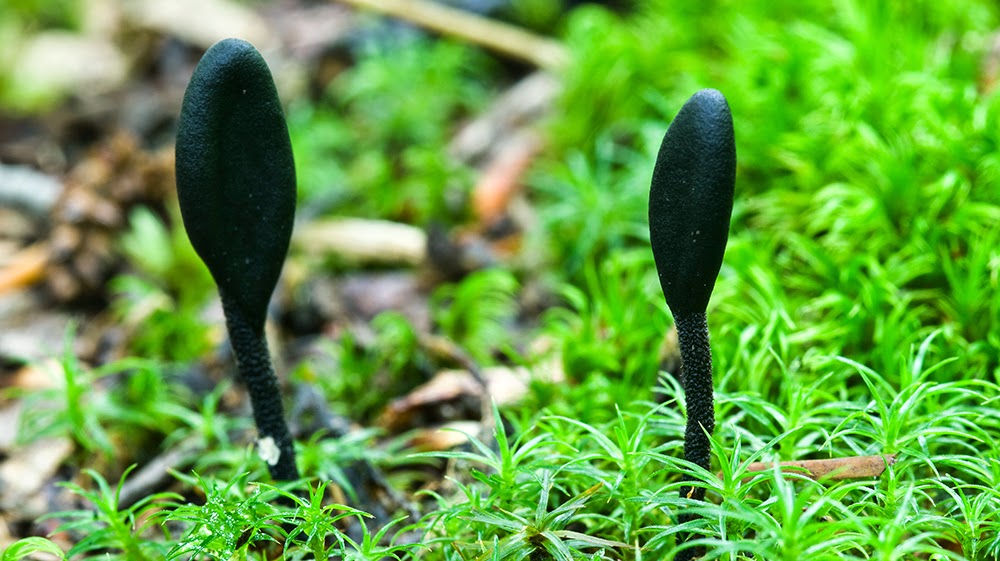
Geoglossum species, Ascomycota, black earth tongues


Tylopilus alboater, the black velvet bolete, a dense and delicious bolete that is often blissfully bug-free

Another gorgeous black trumpet

Wednesday, September 14, 2011

Foraging Report 9/14/2011

Black walnut
I am unhappy to report that there is not too much gathering or foraging going on right now. After we missed some fruits like elderberry (Sambucus nigra) and black cherry (Prunus serotina), we are still keeping our eyes out for grapes (Vitis species), maybe some crabapples, and nuts like hickory (Carya ovata), chestnuts (Castanea species), and black walnuts (Juglans nigra). It is an off-year for the white oak acorns (Quercus alba), which makes the nuts in 2 or 3 year cycles. Usually the grapes are so plentiful and fragrant by now, we find them by using our noses. This year, I am afraid the grapes have succumbed to the dry early summer months and lost the fruit early.


We are very busy preparing for our letterboxing party, Foraging For Letterboxes, this weekend. We have lots of letterboxes planted using foraged foods and animals as themes. We will be preparing several potluck items using our foraged foods: sumac-ade, venison stew, ramps greens biscuits with kielbabsa, pine pollen biscuits with sweet cream cheese, and shortbread-jam dessert bars. At 2:00 PM I'll be leading a short Wild Weed Walk at an alternate location, talking about several common edibles we are familiar with. It is shaping up to be a fun day with our letterboxing friends.

I am also starting to gather some specimens for an educational display we are pacing at the Otis Library here in Norwich, CT for the month of October. There are two glass cases in the entrance lobby that I will fill with information on foraging here in southeastern Connecticut. Last year I placed the display for the first time, and it was very popular. I added some photos, dried plants, nuts, and our jams along with labels and informational cards about who we are and what we do. This year I hope to do more with mushrooms and showcase the recipes we cook with our wild foods.

Autumn olives
Northern bay laurel
While we are on the subject of cooking with wild food, I am excited that we will be a participating forager for a meal at La Laiterie Restaurant in Providence, RI in honor of Hank Shaw and his book tour on October 2. The menu is wide open right now, and we hope to provide several items. Seasonal foods like rosehips, nuts, sea beans, autumn olives, grapes, and flavorings like spicebush berries, sassafras roots, and northern bay laurel. We also have several preserved or dehydrated foods like milkweed flowerbud capers, dried chicken mushrooms, and frozen ramps greens to offer.

Honey mushrooms
Black trumpets
Last, but never least, mushrooms! The recent tropical storm that drenched the area provided ideal conditions for a large flush of mushrooms, and the recent cooler nights are bringing out the autumn mushrooms that we love- chicken mushrooms (Laetiporous sulphureus), honey mushrooms (Armillaria mellea), Hen-of-the-Woods (Grifola frondosa), and our first black trumpets (Craterellus fallax). The chickens are still slow to come, but Robert brought home a 7 pound sack of honey mushrooms yesterday, and they are drying in the dehydrator now. No Hens yet for us, we'll start looking in earnest this week at every oak tree we pass for the large polypore. The black trumpets are a happy accident. I don't know if we would have ever found them if we had been looking for them, but we have stumbled on maybe a pound or two completely by accident this past week. The Northeast Mushrooms Group on Yahoo has been buzzing with news and photos of a banner year for trumpets. We dried them and powdered them, and the aroma is decadent, I can smell sweet hints of fruit and a bit of the mushroom muskiness. I made a small batch of bagels with the powder, and we'll save the rest for something else. Robert is interested in a soup, but not a puréed soup or cream based soup, so we will continue to look for recipes and inspiration. This past Sunday was a potluck party with the Connecticut Valley Mycological Society, and some people made black trumpet pizza, and added it to pasta salad. The array of mushroom dishes was spectacular, and the company matched the food as the potluck followed the Sunday foray. I cooked up some mini Sumac Meringues for potluck dessert. Robert looks forward to each foray for the education and opportunity to find some wonderful edibles.

Saturday, April 30, 2022

Edible Wild Mushroom of Connecticut- In person Presentation, New Britain Public Library, June 14, 6:00 pm


Craterellus fallax, the black trumpet chanterelle

Are you a mycophobe or mycophile? Southern New England offers an incredible array of tastes and textures in its wild mushrooms that can't be found at the grocery store!
 
The 3 Foragers will discuss the best edible wild mushrooms that can be found in Connecticut, and show recipes that have been made with wild foraged mushrooms. Explore the edible treasures by season, and learn the best ways to identify, collect, and prepare wild fungi for the table.
 
Grifola frondoa, maitake


The 3 Foragers have worked with over 150 libraries, nature centers, summer camps, garden clubs, land trusts, and private citizens to learn the wild edible plants and fungi of Southern New England since 2016. Their blog, Facebook page, and book all focus on family-friendly, environmentally sustainable harvest of wild plants and fungi, and ways to incorporate these foods into your diet with original recipes.
Please contact the New Britain Library to register at (860) 224-3155
 
Baorangia bicolor, the bicolor bolete